Navigating a Sharp Market Reset
8 April 2026
March marked a clear shift in market tone. After a relatively stable start to the year, global markets experienced a broad-based pullback as investors repriced growth expectations, reassessed the path of interest rates, and responded to renewed geopolitical uncertainty. Risk assets corrected across regions, and correlations rose, leading to simultaneous declines in both equities and parts of fixed income.
In this environment, short-term performance across diversified portfolios came under pressure. SqSave portfolios were not immune to this drawdown. However, our positioning remained consistent with our investment philosophy: manage risk systematically, avoid reactive decisions, and focus on outcomes over a full investment cycle rather than a single month.
SqSave Investment Performance
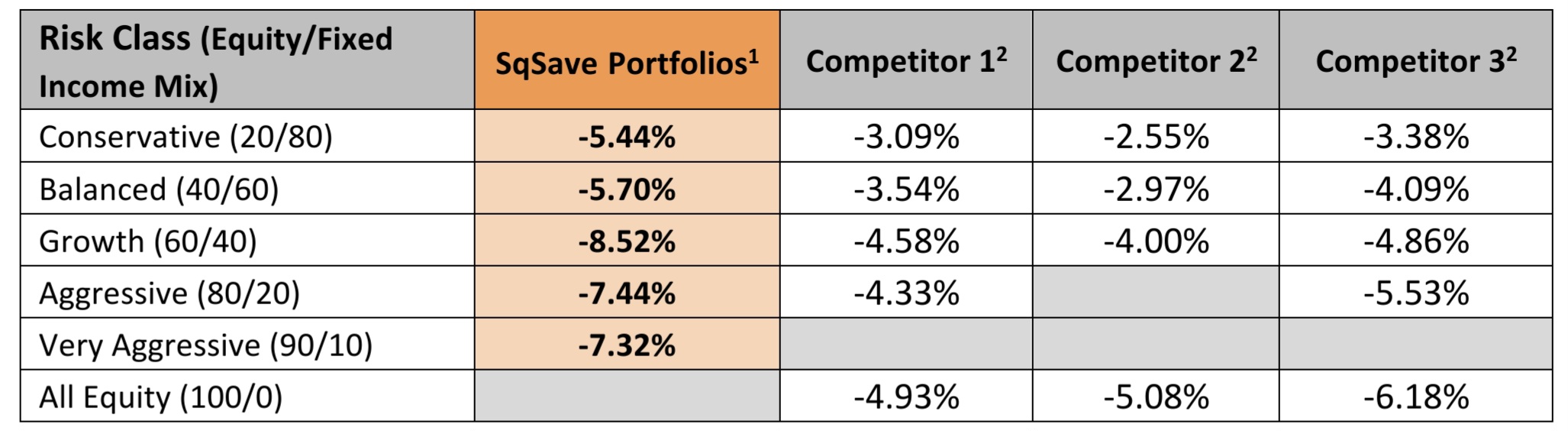
March saw negative returns across most asset classes, with higher equity exposure driving larger drawdowns.
Latest 1 Month Returns - Mar 2026
Key observations:
Drawdowns were broad-based, reflecting a market-wide risk-off move rather than isolated weakness.
Higher equity exposure led to larger declines, as expected in periods of market stress.
Short-term relative underperformance versus peers reflects more diversified positioning, including exposure to assets that corrected alongside equities.
It is important to recognise that such periods are a normal part of investing. Attempts to avoid all drawdowns typically result in missed recoveries. SqSave’s approach remains focused on managing risk while staying invested through the cycle.
Looking Beyond the Month: 3-Year Performance
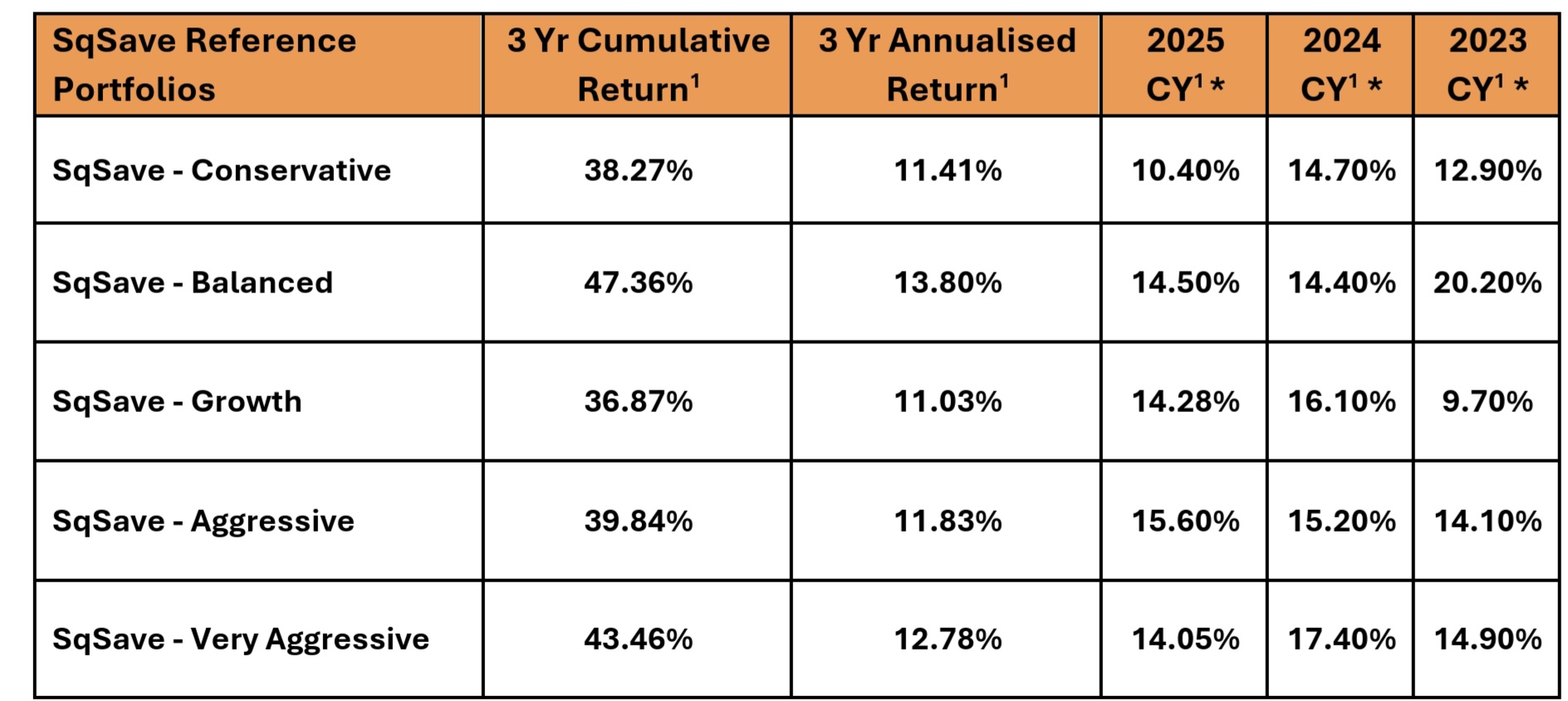
While March was challenging, evaluating performance over a full investment cycle provides a more meaningful perspective.
SqSave Reference Portfolios: 3-Year Performance (31 Mar 2023 - 31 Mar 2026)
*CY Refers to Calendar Year
What this shows:
All portfolios delivered strong double-digit annualised returns over a full three-year cycle.
Balanced portfolios led performance, demonstrating the effectiveness of diversified allocation across varying market regimes.
Even with intermittent drawdowns, long-term outcomes remain robust and consistent.
This reinforces a core principle: short-term volatility is the price paid for long-term returns.
Investment Environment
Several factors contributed to March’s market correction:
Geopolitics – Iran Conflict:
Escalation of the Iran conflict emerged as a key driver of market volatility. Disruptions around the Strait of Hormuz, a critical global energy chokepoint, raised concerns over oil supply and triggered a sharp increase in energy prices.
Oil prices surged above US$100 per barrel amid supply risks and military developments, reinforcing inflation concerns and weighing on global markets.
Energy & Inflation Shock:
- The conflict has effectively introduced a renewed energy-driven inflation risk, with higher oil prices feeding into broader costs across economies. This complicates US and other global central banks’ monetary policies raised growth concerns; as pre-war easing inflation signs have now reversed due to supply chain pressures on energy and other key commodities, including fertilizers; vital to global food production.
Interest Rates:
Markets adjusted expectations for rate cuts, as persistent inflation risks, partly driven by the risk of sustained high energy prices, has led to a “higher-for-longer” outlook for monetary policy.
Growth Concerns:
Rising energy costs and geopolitical uncertainty weighed on global growth expectations, particularly in energy-importing regions.
Equities & Risk Sentiment:
Elevated valuations combined with geopolitical uncertainty triggered broad-based profit-taking, leading to declines across equity markets.
Correlation Shift:
Both equities and bonds weakened simultaneously, as inflation and rate pressures reduced the effectiveness of traditional diversification.
Such environments tend to be volatile but also set the stage for future opportunities as valuations reset.
Outlook
Periods like March are a natural and necessary part of the investment cycle. While uncomfortable, they play a critical role in rebalancing markets and creating opportunities for disciplined investors.
SqSave’s AI-driven approach continues to:
Monitor evolving risk signals
Adjust allocations dynamically
Maintain diversification across asset classes
Rather than reacting to short-term market movements, our focus remains on positioning portfolios for recovery and long-term growth.
History has consistently shown that markets recover over time. The key to capturing that recovery is not timing the market, but remaining invested with a disciplined strategy.
Sincerely,
SqSave Investment Team
Disclaimer
The contents herein are intended for informational purposes only and do not constitute an offer to sell or the solicitation of any offer to buy or sell any securities to any person in any jurisdiction. No reliance should be placed on the information or opinions herein or accuracy or completeness, for any purpose whatsoever. No representation, warranty or undertaking, express or implied, is given as to the information or opinions herein or accuracy or completeness, and no liability is accepted as to the foregoing. Past performance is not necessarily indicative of future results. All investments carry risk and all investment decisions of an individual remain the responsibility of that individual. All investors are advised to fully understand all risks associated with any kind of investing they choose to do. Hypothetical or simulated performance is not indicative of future results. Unless specifically noted otherwise, all return examples provided in our websites and publications are based on hypothetical or simulated investing. We make no representations or warranties that any investor will, or is likely to, achieve profits similar to those shown, because hypothetical or simulated performance is not necessarily indicative of future results.
Footnotes:
1. Portfolio returns are inclusive of ETF expense ratios and net of SqSave management fees. SqSave uses AI to design and manage diversified investment portfolios for each investor. Because SqSave is not an investment fund, there is no single return measure. Instead, every SqSave investor has his/her own investment performance as each investor is managed separately by our SqSave AI. As investors can withdraw and top-up any time, investment returns will be affected by individual investor decisions. Hence, SqSave uses reference portfolios which are actual portfolios managed on an ongoing basis, without any interference with withdrawals or top-ups, to measure investment performance.
2. Performance numbers for peers are estimates.
More Articles more


SqSave Outperforms in 2025 and Over a 3-Year Investment Cycle
Team SqSave
As 2025 draws to a close, it is worth stepping back from month to month market noise and assessing performance over what truly matters to investors: a full investment cycle.
Read more

Holding Steady in Turbulent Waters
Team SqSave
As of end-October, SqSave portfolios beat every competitor in their risk class from Conservative to Very Aggressive.
Read more